SIGNAL / HUNT TOOLING
Demand and opportunity radar
Configure a target market, define the commercial thesis, surface signals, and prioritize where attention belongs.
Bring one address, a weird parcel, a market, a portfolio, or an ugly dataset. Neuruh finds where attention is warranted, tests the evidence, underwrites the options, and turns uncertainty into a decision you can act on.
Multiple evidence families overlap around the parcel. The public view stops here; the next step is source-backed verification.
Neuruh does not treat a property as one row in a CRM. Publicly, the useful abstraction is simple: identity, ownership, land, evidence, market, risk, economics, and strategy converge into one decision object.
The point is convergence. A strange parcel, a tax signal, a neighboring owner, an aggressive valuation, or a zoning question matters only when it changes the decision.
SIGNAL → EVIDENCE → CONSTRAINT → VALUE → STRATEGY → DECISIONOpportunity intelligence can start with one address and end with an acquisition workflow, market hunt, or custom operating system. The public site shows the capability envelope without publishing the proprietary machinery behind it.
Off-market, market, portfolio, and dataset hunts. Surface properties or situations worth attention before you spend time investigating everything.
Reconcile the property, parcel, address, geometry, related parcels, and the identity problems that make public-record research messy.
Investigate ownership context, conveyance history, estate or transition indicators, public title issues, and the difference between who appears related and who can actually act.
Research arrears, public liens, judgments, foreclosure signals, old instruments, and other evidence that can alter basis, timing, or dealability.
Zoning, overlays, parcel shape, adjacency, access, utilities, environmental flags, split or assemblage questions, and highest-and-best-use investigation.
Value ranges, comps, rent, repairs, market speed, downside/upside, land economics, and multiple deal structures against the same evidence.
Ask whether the market is pricing the wrong thing: another parcel, another use, a false distress premise, a curative issue, a development path, or a structure others missed.
Separate what is proven, likely, conflicted, and unknown; quantify what can kill the thesis; and make the next action explicit.
Take the workflow beyond one engagement: acquisition intelligence, research automation, parcel intelligence, ranking, CRM/reporting integration, and governed action inside an operator stack.
A useful investigation is not there to confirm the story you started with. It is there to find out what survives the evidence.
A premise to investigate, not a fact to assume.
Source-backed work challenged the original story instead of dressing it up.
Parcel context, adjacency, constraints, and value became the better line of inquiry.
Conditional path, explicit unknowns, ranked risks, and next actions.
The point is not to defend the first number. It is to tighten the range until the deal structure reflects what the property and market can actually support.
Read the parcel beside its neighbors, shape, access, zoning, surrounding land, utilities, environmental constraints, and the uses the site may actually support.
The unit of work can be one weird property or an entire market. The same discipline scales from a focused case to a repeatable acquisition intelligence pipeline.
Investigate one decision deeply enough to know what is real, risky, missing, and worth doing next.
Rank where diligence deserves attention first instead of treating every record equally.
Scan a geography or asset class for situations ordinary search filters may not expose.
Turn ugly public records, exports, or internal lists into a structured research and decision workflow.
For operators who do not need one dossier—they need the hunt, investigation, underwriting, routing, reporting, and feedback loop to run repeatedly inside their own stack.
Bring in messy lists, public-record data, referrals, forms, or internal exports and normalize them into usable opportunity records.
Make repeatable evidence gathering, contradiction handling, and source-backed research part of the workflow.
Connect spatial context, land questions, ownership context, and opportunity ranking without collapsing everything into one opaque score.
Run appropriate analysis, compare structures, preserve uncertainty, and produce a decision-ready output.
Move qualified intelligence into the operator system, preserve receipts, and keep consequential actions behind the right approval gates.
These historical Neuruh interfaces are not presented as current production products or performance claims. They show the breadth of capability already explored: demand hunting, property analysis, specialist underwriting, and configurable operator tooling.
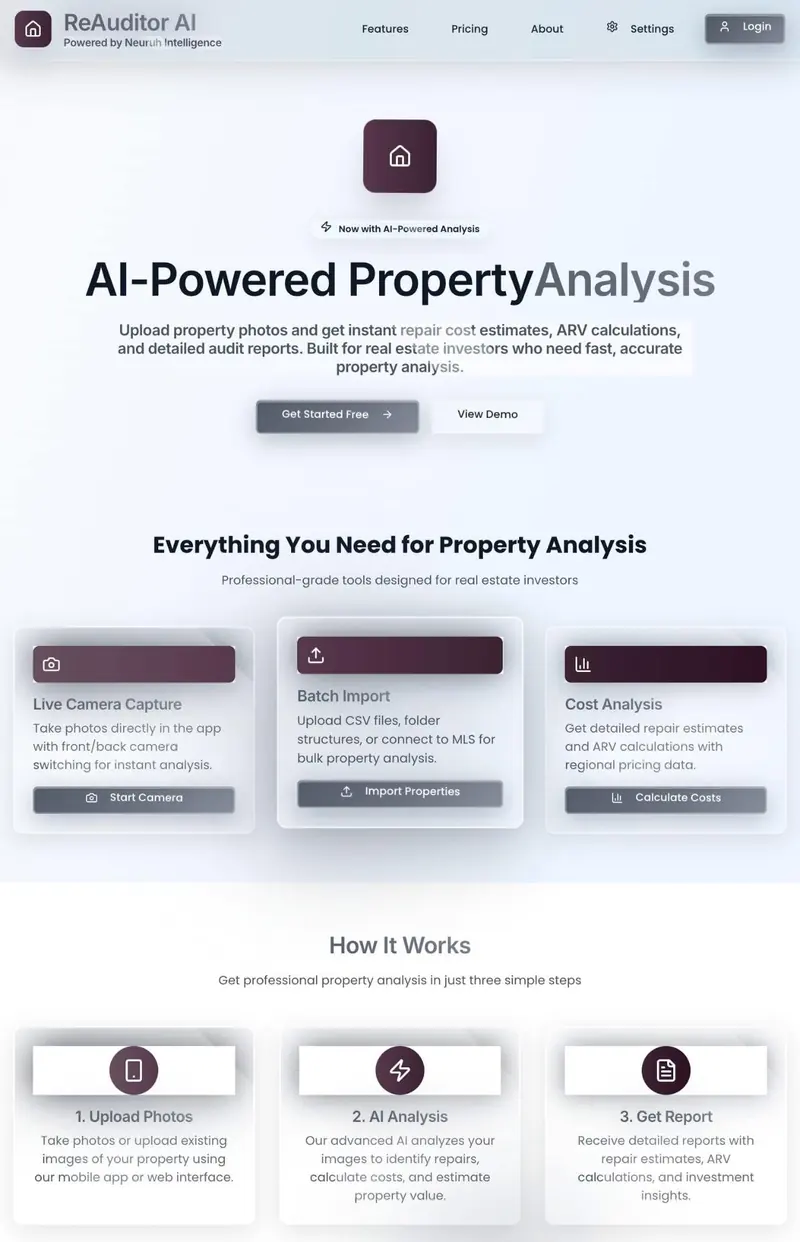
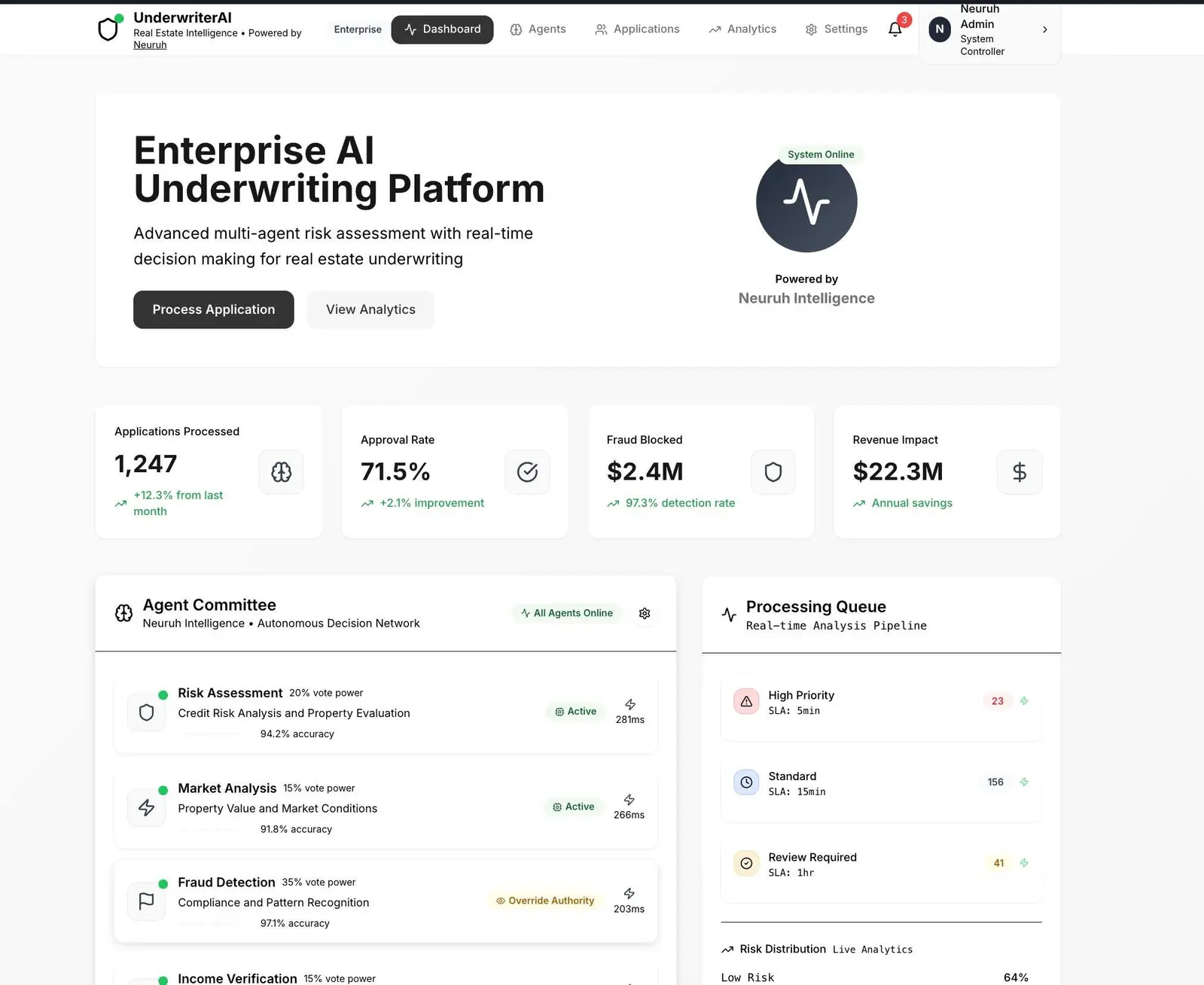
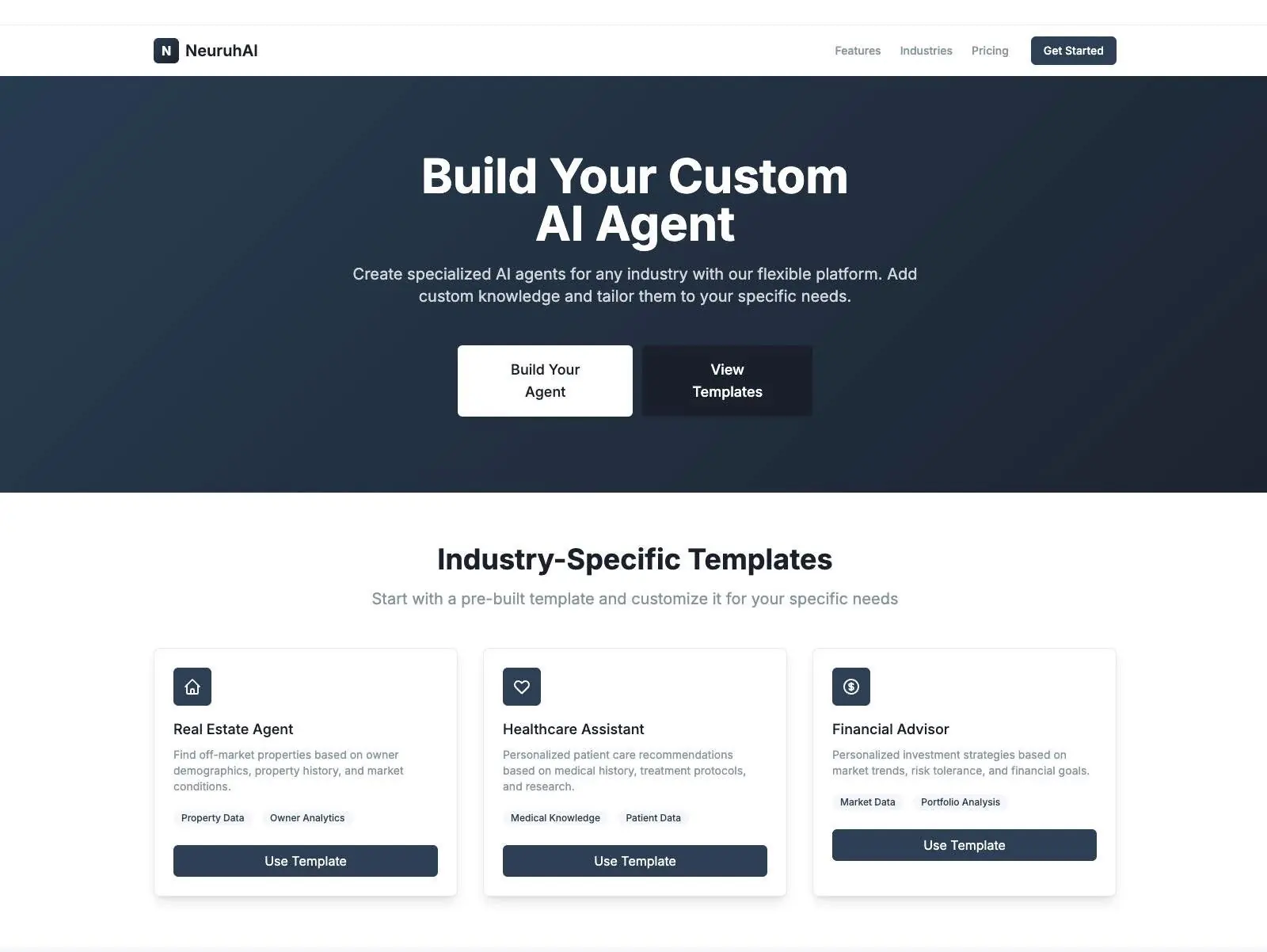
Historical capability lineage only. These screens are used to show design and system breadth; they are not claims that every pictured feature, metric, integration, or interface is currently production-live.
Useful intelligence should make uncertainty visible, not bury it in prose. The output separates what holds up from what still needs work and makes the next action understandable.
What the available evidence actually supports.
What multiple sources indicate but still deserves qualification.
What does not reconcile cleanly and may change the thesis.
What still requires work before capital or action should follow.
What can kill the opportunity, change the basis, or force a different structure.
What should happen next, what it costs, and why it is worth doing.
The public version of the Neuruh economic spine is simple: discover the opportunity, qualify it, investigate it, decide, execute, observe the outcome, and improve the next hunt.
Find where attention is warranted.
Decide whether deeper work is justified.
Test the story against evidence.
Underwrite risk, value, and structure.
Move approved intelligence into action.
Record what actually happened.
Make the next hunt smarter.
The funnel is intentionally simple, but the work is not limited to two report tiers.
One property, parcel, market, ownership situation, or tightly defined question. We identify what matters, what looks risky, what may be non-obvious, and whether deeper investigation is warranted.
Deeper source-backed investigation centered on an actual real-estate decision, with the appropriate property, ownership, land, market, underwriting, risk, and next-action work.
For complicated title or ownership situations, multi-parcel or assemblage opportunities, development questions, acquisition diligence, or a case where the complication is the opportunity.
For investors and operators who want the workflow itself: hunting, ingest, research, parcel intelligence, underwriting, ranking, CRM/reporting integration, and governed execution.